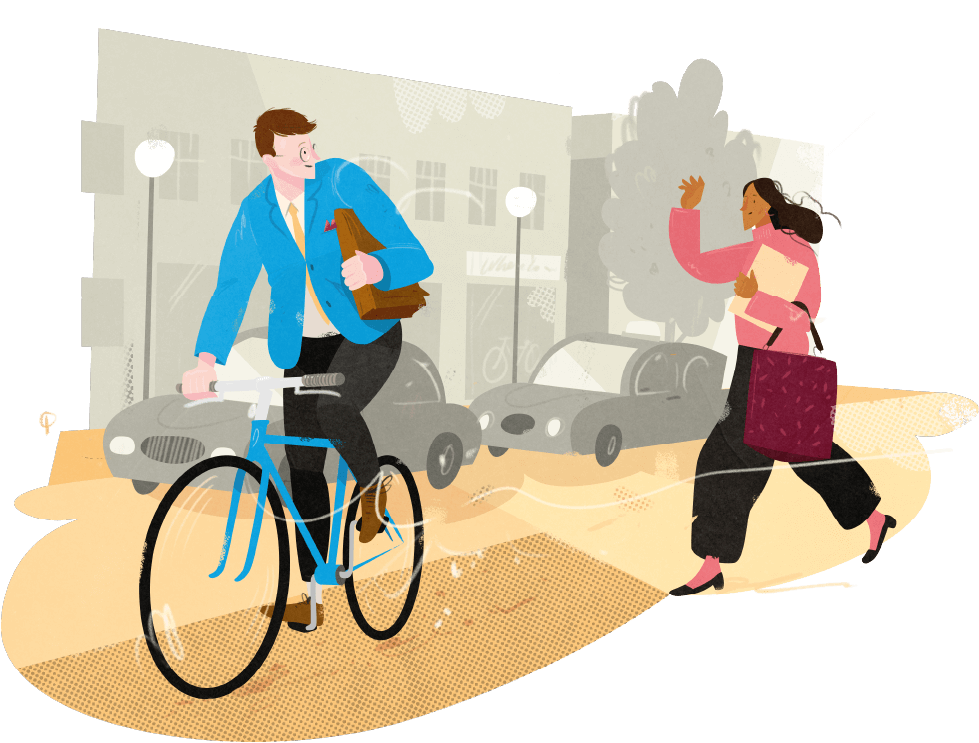
The Running Machine
Karl Freiherr von Drais presents the running machine in Mannheim: two wheels, a wooden frame, no pedals. The birth of the two-wheeler.
We use cookies 🍪 to keep things running smoothly (like logging in). If you’re cool with it, we’d love to use analytics cookies too—they help us make your experience even better. Totally fine if you’d rather not!
An everyday object. A means of transport that replaced horses for personal transportation. But who brought this brilliant invention beneath our backsides — and what influence did it have on our society?
More than a vehicle
The bicycle gave women independent mobility in the 19th century and became a symbol of the women's movement.
Female cyclists wore the first "women's trousers" (bloomers) as early as the 1850s — decades before Coco Chanel.
As the first affordable vehicle, the bicycle enabled workers to get to the factory.
From the running machine to the cycling city: The bicycle has fundamentally transformed urban mobility and continues to do so today.
Zero emissions, no noise, minimal space required: The bicycle is the most sustainable means of transport there is.
From fixies to gravel bikes to cargo bikes: Cycling has long been a conscious lifestyle choice.
On June 12, 1817, a crowd gathered on Mannheim's finest street to witness a curious demonstration: Karl Freiherr von Drais sat astride a wooden frame with two wheels, pushed off from the ground with his feet, and rolled along faster than any pedestrian could run. The running machine was born.
The device was made almost entirely of wood, had a steerable front wheel, and no pedals — essentially a balance bike for adults. But it worked: Drais cut travel time between Mannheim and the Schwetzingen relay station in half. In 1818, he patented the invention as a means of transport in Baden. Just one year later, London coachmaker Denis Johnson improved the design, built a more elegant metal version, and marketed it as the Hobby-Horse — a brief, wild trend in London high society.
"It is a peculiar fact in the history of the bicycle that almost all improvements had to be invented two or sometimes even three times before they came into general use."
Milestones
Karl Freiherr von Drais presents the running machine in Mannheim: two wheels, a wooden frame, no pedals. The birth of the two-wheeler.
Parisian blacksmith Pierre Michaux (or his son Ernest) mounts pedal cranks to the front axle of a draisine. The "Boneshaker" is loud, uncomfortable — and a huge success.
James Starley builds the "Ariel" penny-farthing in Coventry with a giant front wheel and wire spokes. Fast, elegant — and life-threatening in crashes.
John Kemp Starley (nephew of James) invents the "Rover Safety Bicycle": two equal-sized wheels, chain drive to the rear wheel. The basic form of the modern bicycle.
Thanks to industrial manufacturing, pneumatic tires, and falling prices, the bicycle becomes an everyday vehicle for millions.
In Denmark, Morten Rasmussen Mortensen develops the first Long John cargo bike under the SCO (Smith & Co) brand, featuring a low loading platform between the handlebars and front wheel.
The Moulton small-wheelers and Schwinn Stingray spark new trends: compact folding bikes for commuters and the iconic bonanza bike with banana seat for teenagers.
In Marin County, California, pioneers like Joe Breeze and Gary Fisher race down mountains on modified clunkers. The mountain bike is born.
Lightweight lithium-ion batteries and pedal-assist sensors make electric support practical for everyday use. The e-bike revolutionizes commuting and opens up cycling to new audiences.
Bike messengers in New York and San Francisco turn the purist, lightweight single-speed into a cult phenomenon. Urban cycling culture becomes a lifestyle movement.
Name History
Running Machine
The very first name from 1817. You sat on it and ran. Simple, but effective.
Hobby-Horse
Denis Johnson's London version from 1819, named after the children's toy stick horse.
Penny-Farthing
Das Hochrad, benannt nach dem großen Penny und dem kleinen Farthing — wie die beiden Räder.
Velociped
Vom lateinischen „velox“ (schnell) und „pes“ (Fuß). Der elegante Name für frühe Tretkurbelräder.
Reitrad
Eine deutsche Bezeichnung für die Draisine: Man ritt darauf, statt zu laufen.
Boneshaker
Der Spitzname für das Tretkurbel-Velociped der 1860er: Eisenräder auf Kopfsteinpflaster, ohne Federung.
Schadensrisiko
Jetzt absichern